Bookkeeping might not be the most exciting part of running a business, but it’s one of the most important. Imagine trying to run a company without knowing how much money is coming in or going out, it would be like driving with your eyes closed. That’s where double entry bookkeeping comes in.
This system has been the backbone of AI Accounting for centuries, helping small businesses and large corporations alike maintain financial accuracy and transparency.
In this guide, we’ll break down what double entry bookkeeping is, why it matters, how it works, and how you can apply it to your small business with simple examples. Whether you’re a new entrepreneur or someone looking to tighten up your accounting skills, this article is your step-by-step resource.
What Is Double Entry Bookkeeping?
At its core, double entry bookkeeping means that every financial transaction affects at least two accounts. One account is debited and another is credited by the same amount.
This system ensures your books are always balanced:
Assets = Liabilities + Equity
If something doesn’t balance, it means there’s an error that needs fixing.
Example:
- You buy office supplies worth $200 using cash.
- Debit (increase) Office Supplies: $200
- Credit (decrease) Cash: $200
Both sides are equal, so your books remain in balance.
This might sound simple, but it’s the foundation of reliable accounting. Without it, financial records can become inaccurate and misleading.
Double Entry Accounting vs. Single Entry Accounting
Before diving deeper, let’s compare it with single entry bookkeeping, which is often used by freelancers or very small businesses.
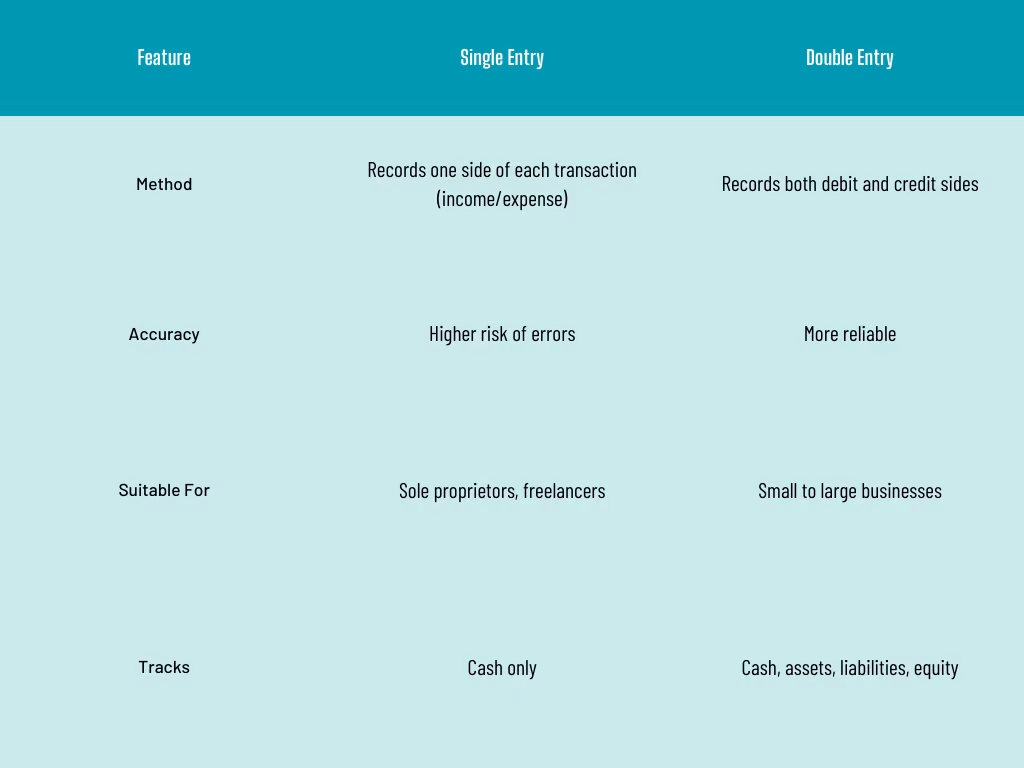
If you’re running a growing business and want clear insights into profits, debts, and financial health, double entry accounting is the way to go.
A Brief History of Double Entry System
The double entry system of accounting dates back to 15th-century Italy. A Franciscan friar named Luca Pacioli, often called the "Father of Accounting" - was the first to describe this method in detail.
His work laid the foundation for accounting as we know it today, and remarkably, the principles haven’t changed much in over 500 years. That’s how powerful and reliable this system is.
Why Double Entry Bookkeeping Matters for Small Businesses
If you’re wondering whether double entry bookkeeping is worth the effort, here’s why it matters:
- Accuracy – Every transaction balances itself, reducing errors.
- Fraud prevention – Harder for mistakes or manipulations to go unnoticed.
- Financial clarity – Provides a complete view of your assets, liabilities, and equity.
- Easier reporting – Essential for preparing financial statements like income statements, balance sheets, and cash flow reports.
- Professional credibility – Banks, investors, and tax authorities prefer double entry records.
Simply put, if you want to scale your business, double entry bookkeeping isn’t optional, it’s essential.
Read More: What Is a General Ledger? Your Complete Overview
Key Concepts in Double Entry Bookkeeping
To truly understand double entry, let’s break down some important terms:
1. Debit (Dr)
- Increases assets and expenses
- Decreases liabilities and equity
2. Credit (Cr)
- Increases liabilities and equity
- Decreases assets and expenses
3. Ledger
The master record where all accounts (assets, liabilities, equity, income, expenses) are tracked.
4. Journal Entry
The first place where a transaction is recorded, showing both debit and credit.
Example journal entry:
You pay $500 for rent.
- Debit Rent Expense $500
- Credit Cash $500
Double Entry Bookkeeping Examples
Example 1: Taking a Loan
- Business borrows $5,000 from the bank.
- Debit: Cash $5,000
- Credit: Loan Payable $5,000
Example 2: Customer Payment
- A client pays you $2,000 for services.
- Debit: Cash $2,000
- Credit: Service Revenue $2,000
Example 3: Paying Salaries
- You pay $1,000 in employee wages.
- Debit: Wages Expense $1,000
- Credit: Cash $1,000
The Double Entry Ledger in Action
A double entry ledger is where all debits and credits are posted.
For example, if you buy $300 of inventory on credit:
- Debit: Inventory $300
- Credit: Accounts Payable $300
In your ledger:
- Inventory accounts show an increase.
- Accounts Payable shows you owe $300.
This provides clarity on both your assets and liabilities.
Financial Statements and Double Entry
The double entry system makes it possible to prepare accurate financial statements:
- Balance Sheet – Shows assets, liabilities, and equity.
- Income Statement – Tracks revenues and expenses.
- Cash Flow Statement – Records actual cash movement.
Without double entry, creating these would be nearly impossible.
How to Implement Double Entry Bookkeeping in Your Business
- Choose Accounting Software
Tools like QuickBooks or Otto AI automate double entry, so you don’t need to manually calculate debits and credits. - Understand Your Chart of Accounts
Categorize transactions into assets, liabilities, equity, income, and expenses. - Record Transactions Promptly
Don’t wait weeks, log transactions as they happen. - Reconcile Regularly
Compare bank statements with your books monthly to spot errors. - Work with an Accountant
Even if you use software, an accountant can provide oversight and advice.
Double Entry Bookkeeping Example for Small Business
Let’s imagine you run a bakery:
- You take a $10,000 loan to start → Debit Cash, Credit Loan Payable.
- You buy baking equipment for $3,000 → Debit Equipment, Credit Cash.
- You sell $500 worth of bread for cash → Debit Cash, Credit Revenue.
- You pay $200 for flour → Debit Supplies, Credit Cash.
At the end of the month, your books show both income and expenses, giving you an accurate picture of profits.
Benefits of Double Entry for Small Businesses
- Helps secure loans by showing accurate financial health.
- Keeps track of debts and prevents overspending.
- Allows for tax-ready reports.
- Builds trust with investors and partners.
Drawbacks of Double Entry Bookkeeping
While powerful, it has some challenges:
- More complex than a single entry.
- Requires training or software.
- Can be time-consuming if done manually.
But with modern AI-based accounting tools like Otto AI, much of the process is automated.
Tips for Small Businesses Starting with Double Entry
- Start simple with a few key accounts.
- Use software to automate entries.
- Keep receipts and invoices organized.
- Review your books weekly, not just at tax time.
The Future of Double Entry Bookkeeping
Even though double entry is centuries old, its future lies in AI-powered automation. Tools like Otto AI can:
- Auto-categorize transactions
- Reduce human error
- Generate instant financial reports
- Save business owners hours of manual work
Instead of crunching numbers, you can focus on growing your business while your accounting runs in the background.
Conclusion
Double entry bookkeeping isn’t just an accounting technique, it’s the language of business. By ensuring every transaction is recorded twice, it provides a complete and reliable view of your company’s financial health. For small businesses, adopting this system means fewer mistakes, clearer reports, and more confidence in financial decisions.