
Imagine running a small business and suddenly realizing your numbers don’t quite add up. You thought you earned a profit, but the books tell a different story. Where’s the error? This is exactly why the trial balance exists.
The trial balance is one of the most important tools in accounting. It doesn’t just check your math, it gives you confidence that your records are accurate before you move on to preparing financial statements.
What Is a Trial Balance?
A trial balance is a report that lists all the accounts in your general ledger and their balances at a specific point in time.
It’s called a “trial” balance because it’s a way of testing whether the total debits equal the total credits. In accounting, every transaction affects at least two accounts, one debit and one credit. If those don’t balance, something’s wrong.
In short:
- A trial balance checks the accuracy of your books.
- It ensures debits = credits.
- It’s prepared before financial statements.
Think of it as a checkpoint in your accounting process.
Trial Balance Meaning in Simple Terms
For beginners, here’s a simpler way to think about it:
- Your ledger is like a diary of all business transactions.
- A trial balance is a quick “audit” of that diary to make sure you didn’t miss or misplace an entry.
If the numbers don’t match, it doesn’t necessarily mean fraud, but it does mean you need to double-check your entries.
What Is the Purpose of a Trial Balance?
The trial balance serves several key purposes in accounting:
- Error Detection
- Identifies mistakes like missing entries, double postings, or transposition errors.
- Identifies mistakes like missing entries, double postings, or transposition errors.
- Accuracy Check
- Ensures that the books are mathematically correct before moving forward.
- Ensures that the books are mathematically correct before moving forward.
- Financial Reporting Preparation
- Forms the basis for creating income statements and balance sheets.
- Forms the basis for creating income statements and balance sheets.
- Audit Trail
- Provides a clear snapshot of accounts at a given date, which helps in audits.
- Provides a clear snapshot of accounts at a given date, which helps in audits.
- Business Clarity
- Gives owners and accountants a chance to spot unusual balances or red flags early.
- Gives owners and accountants a chance to spot unusual balances or red flags early.
Without a trial balance, preparing accurate financial statements would be like building a house without a level.
Types of Trial Balances
There isn’t just one type of trial balance. Businesses often prepare different versions depending on their needs:
1. Unadjusted Trial Balance
- Prepared before making any adjusting entries (like depreciation or accruals).
- Serves as the “first draft.”
2. Adjusted Trial Balance
- Includes adjusting entries to reflect accurate financial performance.
- Used to prepare final financial statements.
3. Post-Closing Trial Balance
- Prepared after closing entries (like transferring net income to retained earnings).
- Ensures only permanent accounts (assets, liabilities, equity) remain open.
Each type has its own role, but all serve the same core function: making sure the books balance.
Trial Balance Format
The trial balance format is fairly simple. It usually has four main columns:
- Account Name – e.g., Cash, Accounts Payable, Sales Revenue
- Account Number – optional but useful for organization
- Debit Balance – amounts recorded as debits
- Credit Balance – amounts recorded as credits
Here’s a sample trial balance format:
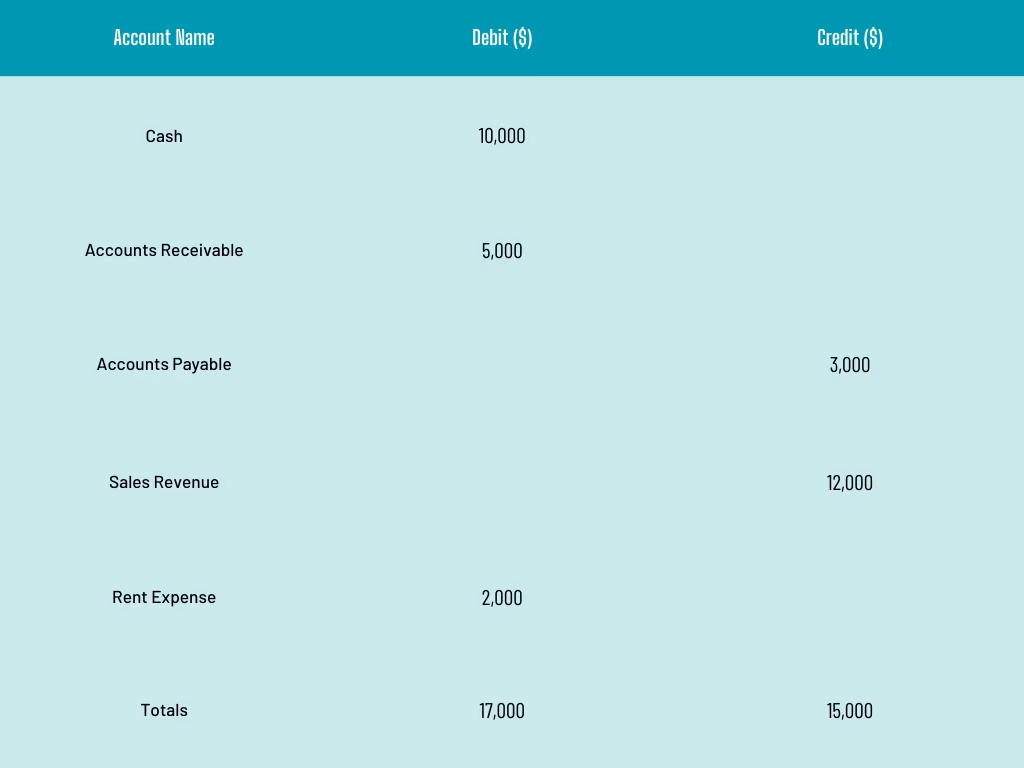
👉 Notice how the totals don’t balance? This signals an error that needs correcting.
Trial Balance Example
Let’s walk through a real-world trial balance example.
Scenario: A small retail store has the following transactions in January:
- Owner invests $20,000 in cash
- Buys inventory worth $5,000 on credit
- Makes sales of $8,000 (cash)
- Pays $1,000 in rent
Trial Balance:
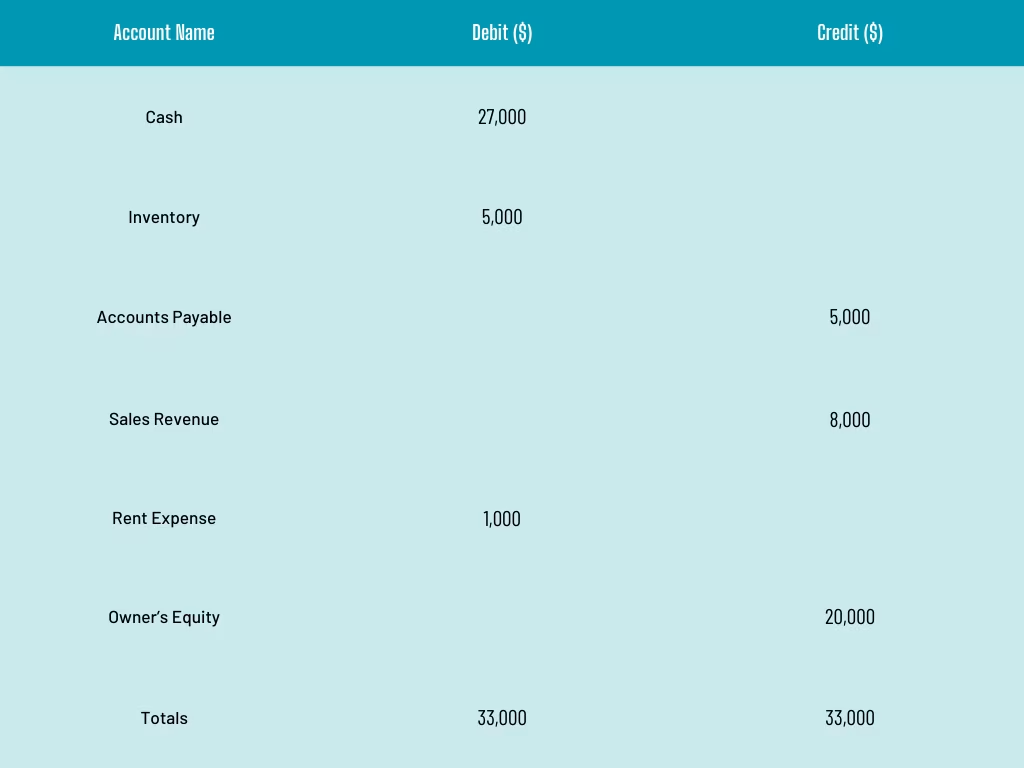
Here, the trial balance balances perfectly, debits equal credits.
What Does a Trial Balance Look Like in Practice?
A trial balance looks like a table with accounts and balances, just like in the example above. Depending on software or manual bookkeeping, it can be simple or highly detailed.
Manual Books: Written in ledgers and balanced by hand.
AI Accounting Software: Automatically generates trial balances and flags errors.
Modern AI accounting software like Otto AI takes this even further, automatically preparing trial balances, spotting unusual transactions, and ensuring accuracy without manual effort.
Common Errors Detected by a Trial Balance
Even if debits equal credits, some errors can slip through. Here are common mistakes a trial balance helps highlight:
- Omission Error: A transaction is left out completely.
- Double Posting: An entry is recorded twice.
- Transposition Error: Numbers are swapped (e.g., $540 instead of $450).
- Wrong Account Posting: An expense is recorded in the wrong category.
- Unbalanced Entries: Debit and credit sides don’t match.
Catching these errors early saves time, money, and potential compliance headaches later.
Trial Balance vs. Balance Sheet
Many beginners confuse a trial balance with a balance sheet, but they’re not the same.
- Trial Balance
- Internal report
- Used to check accuracy
- Lists all accounts with balances
- Internal report
- Balance Sheet
- External financial statement
- Used for reporting to investors, lenders, regulators
- Shows assets, liabilities, equity
- External financial statement
In short: A trial balance is the draft that helps you prepare the balance sheet.
Trial Balance in Modern Accounting
In the past, accountants spent hours manually preparing trial balances. Today, software has made the process faster and more accurate.
How AI Changes the Game
AI-powered tools like Otto AI:
- Automatically categorize transactions
- Generate trial balances instantly
- Detect anomalies in real-time
- Reduce manual effort for small business owners
This shift means less time spent on bookkeeping and more time focusing on strategy.
Why Small Businesses Should Care About Trial Balances
If you’re running a small business, you might wonder: Do I really need to know this?
The answer is yes, because trial balances:
- Help you avoid costly mistakes
- Keep your records audit-ready
- Provide early warnings for financial issues
- Build credibility with banks and investors
Even if you don’t prepare it yourself, knowing what a trial balance is helps you better understand your accountant’s reports.
Conclusion
A trial balance is one of the most fundamental tools in accounting. It ensures your books are accurate, provides a foundation for financial reporting, and helps catch errors before they cause bigger problems.