Avoid These Common Financial Mistakes Creative Professionals Make
Imagine you own several businesses or subsidiaries spread across different countries. Some accounts always have excess cash sitting idle, while others constantly face shortfalls and need funding. Instead of letting money sit unused in one place while borrowing in another, what if you could combine all your accounts into one “pool” to maximize liquidity and minimize borrowing costs?
Whether you’re a small business curious about liquidity management or a finance professional brushing up on treasury strategies, this guide will give you a clear, actionable understanding of cash pooling.
What Is Cash Pooling?
At its core, cash pooling is a liquidity management strategy where a group of accounts (often across multiple subsidiaries or business units) is consolidated to optimize cash usage.
Instead of each account being managed separately, the balances are pooled together, creating efficiency. This helps companies:
- Avoid unnecessary borrowing
- Reduce interest expenses
- Maximize interest income on surplus funds
- Gain a clearer picture of overall liquidity
In banking terms: A cash pooling arrangement is an agreement between a company (or group of companies) and their bank to combine the cash balances of multiple accounts into one central “pool.”
Why Companies Use Cash Pooling
Businesses with multiple subsidiaries or global operations often struggle with fragmented cash management:
- One account may be in overdraft (paying high interest)
- Another account may have idle surplus (earning little or no interest)
Without pooling, you pay more in interest than necessary. With pooling, the company:
- Offsets overdrafts against surplus balances
- Reduces external borrowing
- Gains flexibility to allocate funds where needed
For example:
- Subsidiary A in the U.S. has + $1M surplus
- Subsidiary B in Europe has – $500K overdraft
- Without pooling: Subsidiary B pays interest on the overdraft.
- With pooling: The bank offsets balances, so the group’s net position is + $500K, eliminating borrowing costs.
Also Read: How to Calculate Cash Flow? Step by Step
Types of Cash Pooling
Cash pooling isn’t one-size-fits-all. There are several types, each with different accounting and operational implications.
1. Physical Cash Pooling
Also called zero balancing, this involves physically moving money from subsidiary accounts into a central master account.
- How it works: At the end of each day, surplus balances are transferred to the master account, and deficits are covered by it.
- Pros: Clear, straightforward structure; full control of funds.
- Cons: Can create tax and legal issues due to intercompany loans.
Example: Company A has +$200K, Company B has –$100K. The bank sweeps B’s deficit from A’s surplus into the master account.
2. Notional Cash Pooling
In this setup, money is not physically transferred. Instead, balances are offset on paper for interest calculation.
- How it works: Each subsidiary retains its account, but the bank calculates interest as if balances were combined.
- Pros: Simpler administration, avoids intercompany lending.
- Cons: Limited availability (some jurisdictions restrict it).
Example: Company A has +$300K, Company B has –$150K. The bank calculates interest on the net balance of +$150K, even though no funds move.
3. Hybrid Cash Pooling
A combination of physical and notional pooling. Some subsidiaries physically move funds, while others are netted virtually.
- Useful for multinational companies operating in regions where notional pooling is restricted.
4. Cross-Currency Cash Pooling
For global companies operating in multiple currencies.
- The bank consolidates balances across currencies using FX rates.
- Helps reduce borrowing costs in one currency by leveraging surpluses in another.
- Risk: Exchange rate fluctuations.
Also Read: Automate Your Finances: Time-Saving Tips for Creatives
Notional vs Physical Cash Pooling (Key Differences)
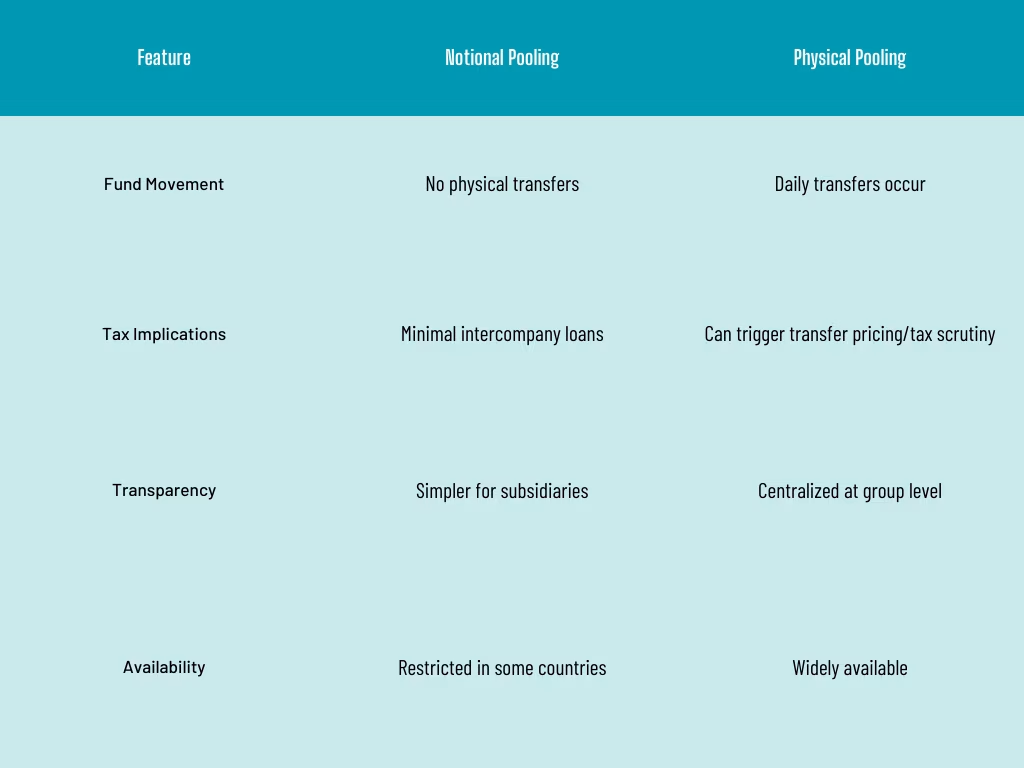
Rule of thumb:
- If you want simplicity → go with notional pooling
- If you want full control of funds → choose physical pooling
What Is a Cash Pooling Arrangement?
A cash pooling arrangement is the formal agreement between a company and its bank detailing:
- Which accounts are included
- Whether the pooling is notional, physical, or hybrid
- How interest will be calculated
- Responsibilities of each subsidiary
- Legal and tax implications
These agreements are critical because improper structuring could lead to:
- Transfer pricing issues (if funds shift between subsidiaries in different countries)
- Regulatory risks (some countries ban notional pooling)
- Liquidity risks if access to funds is unclear
How Cash Pooling Works in Banking
Banks play a central role in setting up and managing cash pooling. Here’s how it typically works:
- Subsidiary Accounts Opened – Each entity has its own account.
- Pooling Setup – Bank links accounts under a pooling arrangement.
- Daily Balance Management – Depending on arrangement, balances are physically transferred (physical pooling) or netted (notional pooling).
- Interest Calculation – Bank applies interest on the net balance instead of individual accounts.
- Reporting – Company receives consolidated liquidity reports for better cash flow planning.
Benefits of Cash Pooling
Companies adopt pooling because of the clear advantages:
- Reduced Borrowing Costs – Lower interest paid on overdrafts.
- Better Liquidity Utilization – Idle cash gets put to work.
- Centralized Cash Visibility – Finance teams see the group’s real liquidity.
- Improved Negotiation Power – Larger pooled balances = better interest rates.
- Operational Flexibility – Subsidiaries can fund each other without external loans.
Also Read: Avoid These Common Financial Mistakes Creative Professionals Make
Risks and Challenges of Cash Pooling
Like any financial strategy, pooling isn’t risk-free:
- Regulatory Restrictions – Notional pooling is banned in some countries.
- Tax Complexity – Intercompany loans may raise transfer pricing issues.
- FX Risk – In cross-currency pooling, exchange rates can reduce benefits.
- Subsidiary Resistance – Local managers may dislike losing autonomy over cash.
- Bank Dependency – Heavy reliance on banking partner’s infrastructure.
Solution: Companies must carefully design cash pooling structures with tax, legal, and treasury advisors.
Cash Pooling Accounting
Accounting for cash pooling depends on the structure.
- Physical Pooling:
- Treated as intercompany lending (surpluses and deficits recorded as loans).
- Requires documentation for compliance.
- Treated as intercompany lending (surpluses and deficits recorded as loans).
- Notional Pooling:
- No intercompany loans.
- Only interest allocation entries are recorded.
- No intercompany loans.
Tip: Many companies set up in-house banks or treasury centers to manage cash pooling more efficiently.
Real-World Cash Pooling Example
Let’s imagine a multinational group, GlobalTech Inc., with subsidiaries in three countries:
- U.S. Subsidiary: + $2M surplus
- Germany Subsidiary: – $1.5M overdraft
- Singapore Subsidiary: + $500K surplus
Without Cash Pooling:
- U.S. earns little interest on $2M.
- Germany pays heavy overdraft interest.
- Singapore earns small returns.
With Notional Cash Pooling:
- Bank nets balances: +$1M total.
- Germany’s overdraft is offset.
- The group pays no overdraft interest.
Result → Group saves hundreds of thousands in interest annually.
When Should a Business Use Cash Pooling?
Cash pooling is most useful when:
- You operate multiple subsidiaries in different regions.
- You face both cash surpluses and deficits across accounts.
- You want to reduce reliance on external borrowing.
- You need better control of group liquidity.
If you’re a small business with only one account, pooling may not be necessary. But as soon as you expand into multiple entities or currencies, it becomes a powerful tool.
Conclusion
Cash pooling is one of the most effective liquidity management strategies for businesses with multiple accounts or subsidiaries. By consolidating balances—either physically or notionally—companies can:
- Reduce borrowing costs
- Maximize the use of idle cash
- Improve visibility and financial control
But, it’s not without risks. Tax, legal, and regulatory issues must be considered before setting up a cash pooling arrangement.