Have you ever thought you could wish that bookkeeping would do itself? Spend decades under spreadsheets, invoices and reconciliation, small business owners and accountants. However, with the emergence of AI accounting software in 2025, businesses will have to change the way they handle their finances.
AI does way more than simply automate repetitive tasks, it is a form of thinking ahead. Whether it is predicting cash flow or classifying expenses in seconds, the correct tool can save hours per week and provide business owners with real-time insight into their figures.
This guide will guide you through the process of making smarter financial decisions with AI whether you are a freelancer, a startup founder, or a CFO of an expanding company.
What Is AI Accounting Software?
At its core, AI accounting software — often offered as a B2B SaaS subscription — combines traditional accounting tools with artificial intelligence. Instead of just recording transactions, it analyzes them, learns from patterns, and helps forecast future outcomes.
Some capabilities include:
- Automated data entry: On the receipts or invoices, no more manual data entry.
- Categorization Smart: AI identifies expenses and allocates it to the appropriate account.
- Cash flow forecasts: Know in advance where shortages may occur.
- Detection of errors: Instantly detect duplicated spots or incorrect records.
- AI-driven reporting: Don’t crunch the numbers to gain insights.
In short, AI helps move accounting from reactive (recording the past) to proactive (shaping the future).
Read More: AI in Accounting: Practical Applications, Trends & Tools
Why AI Matters in Accounting in 2025
Traditional accounting tools are great at storing data, but they fall short when it comes to providing insights. AI closes that gap.
Here’s why it matters now more than ever:
- Time: Bookkeeping automation helps save up to 10+ hours a week to small business owners.
- Better precision: Machine learning eliminates the chances of human error.
- Scalability: AI can scale as your business expands, and it does not require a complete accounting staff.
- Live decision-making: View live financial dashboard rather than receive monthly reports.
- Cost efficiency: cut down on the use of expensive manual bookkeeping services.
With these benefits, AI accounting software isn’t just a tool, it’s a growth partner. To scale safely, many companies integrate an enterprise password manager to secure their expanding digital infrastructure.
Key Features to Look for in AI Accounting Software
Before diving into the top picks, let’s break down the must-have features:
- Automation - Invoice, expense, reconciliations.
- AI Insights Predictive analytics, expense categorization, trend spotting.
- Integrations Sync with banks and payment apps and e-commerce platforms like Alidrop.
- Scalability - Manages freelancers, startups, and expanding teams.
- Security – Data storage is encrypted and complies with financial regulations.
- User-Friendliness - No sharp learning curve, user-friendly dashboards.
These features ensure your accounting tool doesn't just save time, it also helps you make smarter decisions, especially when supported by reliable AI Integration Services.
The Best AI Accounting Software of 2025
Now let’s look at the leading players. While there are many tools in the market, we’ll highlight six major ones:
1. Otto AI (Best for Small Businesses & Freelancers)
Otto AI is designed specifically for small businesses, freelancers, and startups that want to simplify bookkeeping. Instead of overwhelming users with complex accounting jargon, Otto AI focuses on clarity, automation, and ease of use.
Key Features:
- Automated bookkeeping (no manual data entry)
- Smart expense categorization with AI learning
- 1099 and tax-ready reports generated instantly
- Profitability dashboard and real-time cash flow reports
- Integrations with banks and payment processors
Why Choose Otto AI?
Otto AI stands out because it’s not just accounting software, it’s like having a virtual finance assistant. For entrepreneurs who don’t have the time (or budget) for a full accountant, Otto AI bridges that gap affordably.
2. QuickBooks (Best for Established Businesses)
QuickBooks is a long-time leader in small business accounting. Its move into AI has made it even more powerful.
Key Features:
- AI-powered receipt scanning
- Predictive cash flow forecasting
- Customizable financial reports
- Payroll integration
3. FreshBooks (Best for Service-Based Businesses)
FreshBooks has built a strong reputation for being user-friendly, particularly for freelancers and agencies.
Key Features:
- AI-enhanced invoicing and expense tracking
- Time-tracking and project-based billing
- Mobile-first design for on-the-go bookkeeping
4. Wave (Best Free Option)
Wave remains a top pick for businesses that want solid features without a hefty price tag.
Key Features:
- Free invoicing and expense tracking
- AI-powered categorization
- Optional paid add-ons like payroll and payments
5. Xero (Best for Global Businesses)
Xero is known for its international reach and powerful integrations.
Key Features:
- AI-assisted bank reconciliation
- Multi-currency support
- Strong ecosystem of integrations (over 1,000 apps)
6. Sage (Best for Larger Teams)
Sage has been around for decades, serving medium to large businesses. Its AI features are designed for more complex accounting needs.
Key Features:
- Advanced financial forecasting
- Strong compliance and audit tools
- Scalable for growing organizations
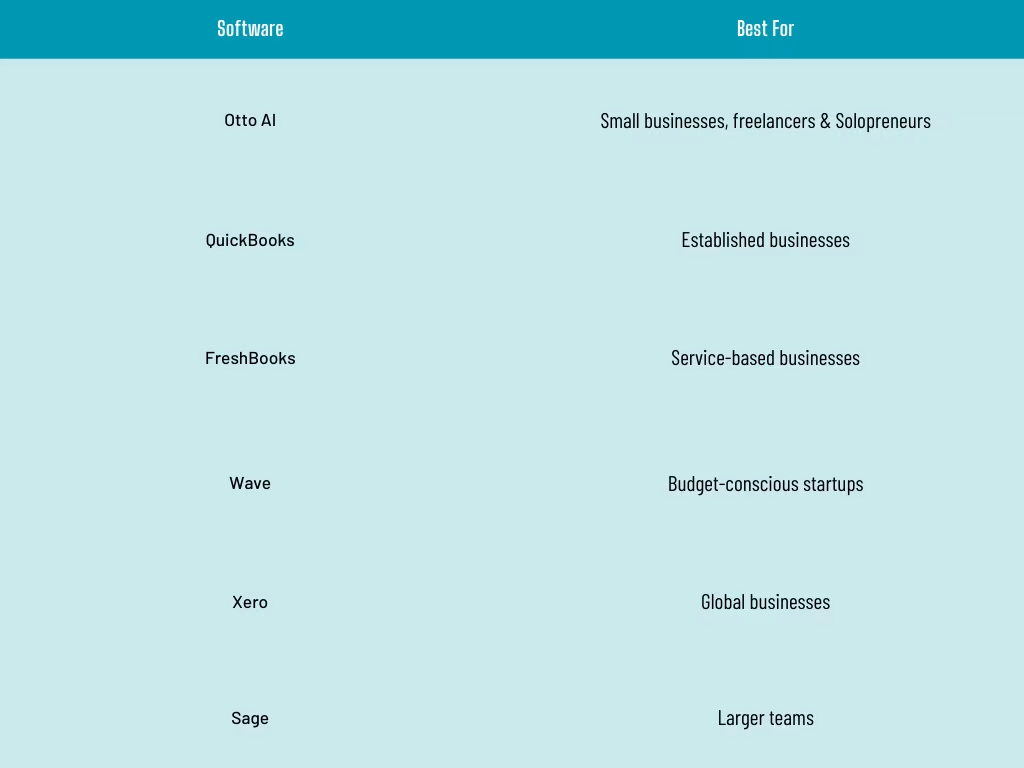
Otto AI vs. Competitors: A Quick Comparison
How to Choose the Right AI Accounting Software
Not every tool is right for every business. Here’s a quick framework to help you decide:
- Freelancer/solo entrepreneur: Otto AI or FreshBooks
- Startup on a budget: Wave or Otto AI
- Established small business: QuickBooks or Xero
- Medium-sized business with a team: Sage or QuickBooks
- Global or e-commerce focus: Xero
Always consider cost, usability, and scalability before making your choice.
Future of AI in Accounting
The future looks bright. By 2030, experts predict that:
- 90% of bookkeeping tasks will be automated
- AI will generate financial insights in real-time
- Businesses will rely less on manual reporting and more on predictive analytics
As these tools mature, Agentic AI will play a bigger role in accounting by coordinating multi-step tasks end-to-end, from pulling data and reconciling entries to prompting humans only when decisions or approvals are needed.
In other words: accountants won’t disappear, but their roles will shift from data entry to strategy and analysis.
Conclusion
AI accounting software in 2025 is no longer a luxury, it’s a necessity. From Otto AI’s simple automation to Sage’s enterprise solutions, there’s a tool for every stage of business.
The right choice depends on your size, budget, and goals. But one thing is certain: AI in accounting isn’t just about saving time. It’s about gaining the clarity and confidence to grow your business.