Are eSignatures legal?

Short answer: YES!

For the long answer, keep reading.

"eSignatures cannot be invalidated simply due to being electronic."

Legislation Under the ESIGN Act – USA, June 30, 2000

The ESIGN Act ensures electronic signatures are both legally binding and enforceable across the U.S.

Such legislation supports the global recognition of eSignatures for business purposes.

Despite variations in laws, eSignatures are broadly accepted as legitimate as traditional signatures.

Otto AI complies with global eSignature guidelines, ensuring secure and confident signing.
Explore eSignature Legality by Country

Holds in court? No
Can it be used for Business? No
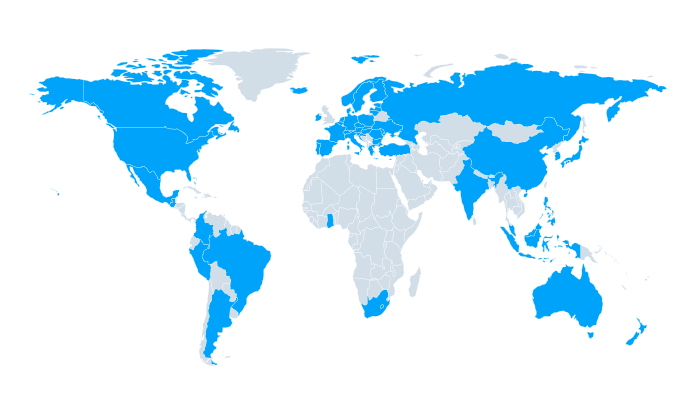
World map showing eSignature legality

List of countries where
eSignatures are legal

An eSignature has the exact same legal power as a handwritten
signature as long as it meets the requirements of the specific
regulation it was created under.

United States

United States

Uniform Electronic Transactions Act (UETA) – Electronic Signatures in Global and National Commerce Act

Canada

Canada

Personal Information Protection and Electronic Documents Act (PIPEDA)

United Kingdom

United Kingdom

The Electronic Identification Regulation (EU/910/2014) (2014)

China

China

Electronic Signature Law of the People's Republic of China

India

India

Information Technology Act, 2000

Germany

Germany

eIDAS (Electronic Identification, Authentication and Trust Services)

France

France

eIDAS (Electronic Identification, Authentication and Trust Services)

Spain

Spain

eIDAS (Electronic Identification, Authentication and Trust Services)

Italy

Italy

eIDAS (Electronic Identification, Authentication and Trust Services)

Russian Federation

Russian Federation

Federal Law of Russian Federation about Electronic Signature (06.04.2011)

Japan

Japan

Law Concerning Electronic Signatures and Certification Services, 2000

South Korea

South Korea

Digital Signature Act

Turkey

Turkey

Electronic Signature Law

Switzerland

Switzerland

Federal Law on Certification Services Concerning the Electronic Signature, 2003

Brazil

Brazil

Medida provisória: 2.200-2

Frequently Asked Questions About eSignatures

Are eSignatures legally binding?

^

Absolutely. eSignatures are legally binding almost everywhere in the world and across virtually every industry. They hold up in court and can be used as evidence. Digital tracking in eSignatures ensures signature verification by recording signer's IP and timestamp. Learn more about eSignatures here.

Can I sign any kind of document with eSignatures?

^

Yes. According to the Electronic Signatures in Global and National Commerce Act (ESIGN – USA), a contract or signature "may not be denied legal effect, validity, or enforceability solely because it is in electronic form". eSignatures are accepted across all industries and use cases. Find Secure Contract Solutions templates for your business here.

Can I sign on a PDF with eSignatures?

^

Yes, you can sign PDFs. Otto AI also supports PNG and JPG files, plus Word documents. You can connect Google Drive, Dropbox, Box, and OneDrive to upload your documents directly.

I've never used an eSignature before. Is it the same as a manual signature?

^

It's exactly the same. The only difference? You can sign from anywhere in the world without printing anything. Otto AI allows signature customization: draw, type, or upload your signature.

Is the audit trail of eSignatures as legally binding as paper archives?

^

Absolutely. Otto AI creates a complete digital record of every interaction you and other signers have with your documents. This makes documents easy to track and recover anytime, right from your account—no need to store stacks of paper files. eSigned documents have been used as evidence in court for years.

Do I need to keep a paper record for my eSigned documents?

^

No need. You can save, track, and access all your documents in your Otto AI dashboard. Digital records are just as valid as paper records for audits, legal proceedings, and compliance requirements.

Some people still prefer to sign on paper. What should I do?

^

When clients or partners hesitate about eSignatures, it's a chance to show them the benefits. Point them to the relevant eSignature laws in their country. After realizing eSignature efficiency, clients will appreciate the transition towards a streamlined signing process.

What are cases in which eSignatures definitely don't work?

^

eSignatures work for most documents and make signing faster and easier. However, some documents require extra verification, notarization, or witnesses that go beyond what a standard eSignature provides. Documents that typically need more than an eSignature include:

  • Wills
  • Sworn declarations
  • Powers of attorney
  • Major financial transactions that require notarization

Send Invoices
That Get You Paid Fast

Join hundreds of businesses using Otto AI to invoice smarter, get paid faster, and spend less time formatting columns.

Start Your Efficient Invoicing Experience